

The project assessed the impact of small catchment dams on river flows in the Moorabool and Maribyrnong catchments, and the catchment values that depend on these rivers. The project was informed by new data, and insights from a Stakeholder Reference Group, who also identified a range of opportunities to improve the way small catchment dams are managed in the future.
-
Summary of study
This project forms part of the implementation of the Central and Gippsland Region Sustainable Water Strategy and is specifically related to Action 4 -13 ‘Review of water resource risks in small, dry, peri-urban catchments’.
This study has examined the impact of small catchment dams on river flows and the associated cultural, environmental, social and economic values in the upper Moorabool and upper Maribyrnong catchments. The project has confirmed that the cumulative impact of small catchment dams on river flows and the associated values is significant in these two catchments, particularly in dry years. The study has also recorded that the number of small catchment dams has continued to grow in the Moorabool and Maribyrnong catchments.
It is important to note that there are other underlying risks to water resources in these catchments beyond the impact of small catchment dams that have not been assessed as part of this study. These risks may include land use change, the potential impact of existing large storage reservoirs, river and groundwater diversions and the impact of a changing climate.
The study has focused on understanding the cumulative risk posed by small catchment dams in these two small, peri-urban, and highly flow stressed catchments. Due to the focus on risks, the study and this report do not highlight the social and economic value of small dams in the Moorabool and Maribyrnong catchments.
Small catchment dams provide important stock and domestic water supplies, water for fire prevention or suppression, lifestyle and recreational values, and local environmental values. These important values will need to be further explored and considered.
A Stakeholder Reference Group of 20 people was established to improve our shared understanding of the water resource challenges facing the area and to inform the content and outcomes of the project. This group included a diverse range of individuals and organisations including local landowners, community members, industry groups, Traditional Owners, government agencies and water corporations.
The group met six times to highlight the values, issues and opportunities in the Moorabool and Maribyrnong catchments in relation to small catchment dams. Having such a diverse range of stakeholders was crucial to the success of the project and we would like to thank all those who took part and contributed.
The report captures the full suite of ideas and opportunities identified by the Stakeholder Reference Group that could help to reduce the future impacts of small catchment dams in the upper Maribyrnong and upper Moorabool. The project did not attempt to prioritise the ideas or seek agreement from the different stakeholders on whether they supported the ideas raised by others in the group.
Over 60 different ideas and opportunities were identified. These include educational opportunities aimed to support the community’s understanding of farm dam licence requirements, on farm water efficiency opportunities, operational improvements to support the licensing and compliance functions of agencies, and potential state policy and legislative reform. The ideas and opportunities identified by members of the Stakeholder Reference Group in this report do not necessarily reflect the views of Southern Rural Water.
While ongoing management of small catchment dam continues – including community engagement, monitoring, reporting and compliance activities - further analysis of the ideas and opportunities raised by the stakeholder group is needed prior to taking action.
The next step is for the report findings, alongside the ideas and opportunities identified by the Stakeholder Reference Group to be considered by the government and its agencies.
This project aligns with our role as a regulator of surface and groundwater use in the Moorabool and Maribyrnong catchments and our continuing investment in compliance to ensure everyone follows the rules.
We have bolstered our zero-tolerance approach to non-compliance by providing dedicated enforcement staff, including compliance training for operational team members and implementing successful targeted investigation programs.
Southern Rural Water has completed an investigation into potentially non-compliant dams within the Moorabool Catchment and has commenced investigations within the Maribyrnong, Mornington Peninsula and Hopkins Basin Catchments. There are currently several enforcement actions underway.
-
Full study report
Review of Water Resource Risks in the Upper Moorabool and Upper Maribyrnong Catchment download the full report here.
-
Project map
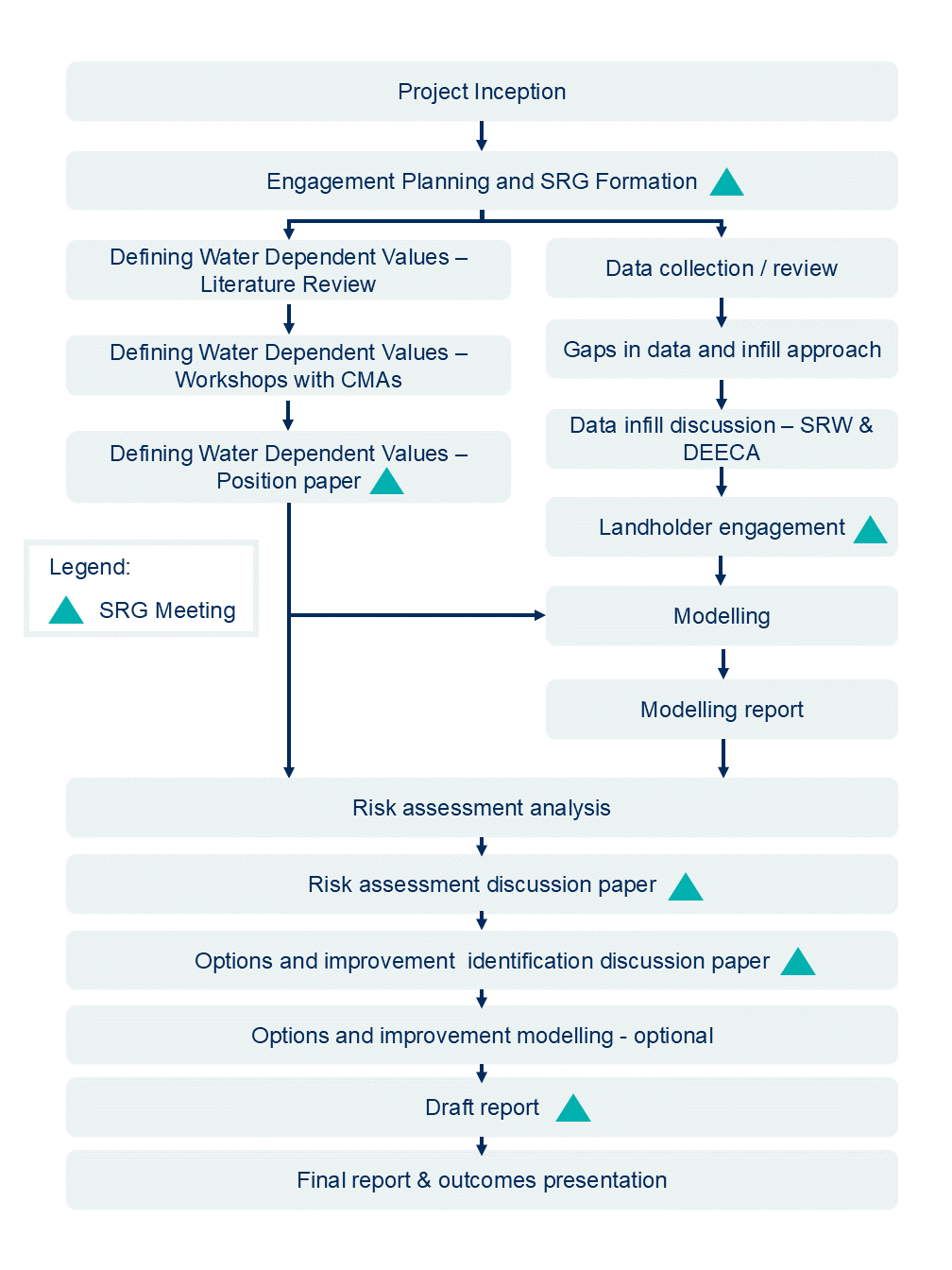
Figure 1 Project Map
-
Stakeholder Reference Group
Stakeholder reference group meeting 1 - Meeting notes
Stakeholder reference group meeting 2 - Meeting notes
Stakeholder reference group meeting 2 - Overview of Catchment Value
Stakeholder reference group meeting 2 - Domestic stock legislation, policy and implementation
Stakeholder reference group meeting 3 - Paper on modelling methodology
Stakeholder reference group meeting Meeting 4 - Risk assessment overview paper
Stakeholder reference group meeting Meeting 4 - Briefing Pack
Stakeholder reference group meeting Meeting 4 - Impact of farm dams on streamflow
Stakeholder reference group meeting Meeting 5 - Discussion paper
Stakeholder reference group meeting Meeting 5 - Meeting notes
Stakeholder reference group meeting Meeting 6 - Meeting notes
FAQs
-
Why has this project been undertaken?
This project delivers Action 4-13 from the Central and Gippsland Sustainable Water Strategy, released in 2022, which committed to a review of water resource risks in small, dry, peri-urban catchments. The action focused on the Moorabool and Maribyrnong catchments that are recognised as being flow stressed, and subject to community concerns about increasing pressure from small-scale agriculture and changing land use, with increasing urban and semi-rural development, against the backdrop of a changing climate.
-
How was the project undertaken?
The project included the collation of data on small catchment dams (including data from local community groups). Hydrological modelling was then used to determine the impact of small catchment dams on river flows and the water dependent values that depend on these rivers. An important element of this project was the guidance, perspectives, and information that stakeholders within the catchment provided. This took place through the Stakeholder Reference Group that was formed and met six times at key milestone stages throughout the project.
The Stakeholder Reference Group identified over 60 ideas and opportunities that could improve the management of small catchment dams and help to mitigate their impacts on these catchments in the future. The Stakeholder Reference Group identified educational opportunities aimed to support the community’s understanding of farm dam licence requirements, on farm water efficiency opportunities, operational improvements to support the important licensing and compliance functions of agencies, and potential state policy and legislative changes.
-
What are the key findings from this project?
Overall, the assessment confirms that small catchment dams are likely to reduce river flows and impact on the associated environmental, economic, social, and cultural values, with the greatest impacts occurring during low-flow periods. Average modelled reductions in catchment runoff in the summer and autumn periods were in the region of 15-17 percent and exceeded 30 percent in some very dry seasons.
The report highlights that growth in small catchment dams, including enlargement of dams, has continued since the last study in 2009/10, and this growth is likely to have had a small but significant impact on flows (increasing the mean annual impact by 5-9%).
The Stakeholder Reference Group identified over 60 ideas and opportunities that could improve the management of small catchment dams and help to mitigate their impacts on these catchments in the future. This included educational opportunities aimed to support the community’s understanding of farm dam licence requirements, on farm water efficiency opportunities, operational improvements to support the important licensing and compliance functions of agencies, and potential state policy and legislative changes.
These ideas and opportunities will provide insights to the responsible agencies when they consider the future management of small catchment dams.
-
Who was involved in the delivery of this project?
The project was undertaken by Southern Rural Water and was funded by the Department of Environment, Energy and Climate Action (DEECA). SRW appointed Alluvium Consulting and Hydrology and Risk Consulting to assist with the delivery of the project.
-
What are the next steps?
Department of Environment, Energy and Climate Action (DEECA) acknowledges the importance of existing water rights and value that small catchment dams provide landholders and communities.
The next stage will be to consider the findings of this project including the ideas and opportunities for improved water management identified by the Stakeholder Reference Group. DEECA will continue the conversation with stakeholders and agencies involved in this project to inform the development of a DEECA-led action plan.
In parallel, Southern Rural Water continue to invest in compliance to ensure everyone follows the rules.
We have bolstered our zero-tolerance approach to non-compliance by providing dedicated enforcement staff, including compliance training for operational team members and implementing successful targeted investigation programs.
We have completed an investigation into potentially non-compliant dams within the Moorabool Catchment and have commenced investigations within the Maribyrnong, Mornington Peninsula and Hopkins Basin Catchments. There are currently several enforcement actions underway.