

Carbon reforestation offsets involve planting trees to capture carbon dioxide from the atmosphere and contribute to reducing the effects of climate change. To reach our net zero target, Southern Rural Water has committed to generating carbon reforestation offsets, which helps reduces emissions.
Our carbon reforestation offsets project could remove up to 23,000 tonnes of carbon dioxide from the atmosphere over 25 years, which will generate carbon credits to support Southern Rural Water’s emissions reduction plan.
Southern Rural Water is already reducing greenhouse gas emissions through the transition of vehicle fleet towards zero emissions by 2030, partnering with Wannon Water to exchange Australian Carbon Credit Units, and generating and purchasing renewable electricity.
Benefits of planting for carbon offsets
There are multiple co-benefits associated with planting trees to generate carbon offsets. By planting species that are native to the local area, it will create habitat corridors for a wide range of fauna and protect and enhance the biodiversity of the existing flora across the landscape.
Reforestation of our land will also remove invasive flora and fauna species and improve the resilience of local ecosystems.
Reforestation will reduce nitrogen and phosphorous runoff into our water storages and prevent sedimentation, with subsequent benefits for water quality. By vegetating the area around our storages, the forested area will help to reduce erosion along the banks, improving water quality and overall integrity of the storage.
Reforestation will also increase organic matter and infiltration rates within the topsoil, improving overall soil health.
What is involved in planting?
Carbon reforestation offsets involve planting trees to capture carbon dioxide from the atmosphere and contribute to reducing the effects of climate change.
Planting involves a mixture of native and local tree, shrub and understorey species to establish new and permanent forest cover. These projects earn one Australian Carbon Credit Unit (ACCU) for each tonne of carbon dioxide equivalent (tCO2-e) sequestered by trees as they grow.
We are already reducing our greenhouse gas emissions through the transition towards electric vehicles and generating and purchasing renewable electricity. Planting trees to generate carbon offsets will help us to mitigate our climate change impacts, whilst improving the climate resilience of the catchment.
Where are plantings taking place?
We have assessed our land holdings across southern Victoria to find suitable locations at Lake Merrimu, Lake Glenmaggie and Blue Rock Lake to generate carbon reforestation offsets to achieve our net-zero greenhouse gas emissions target.
Lake Glenmaggie
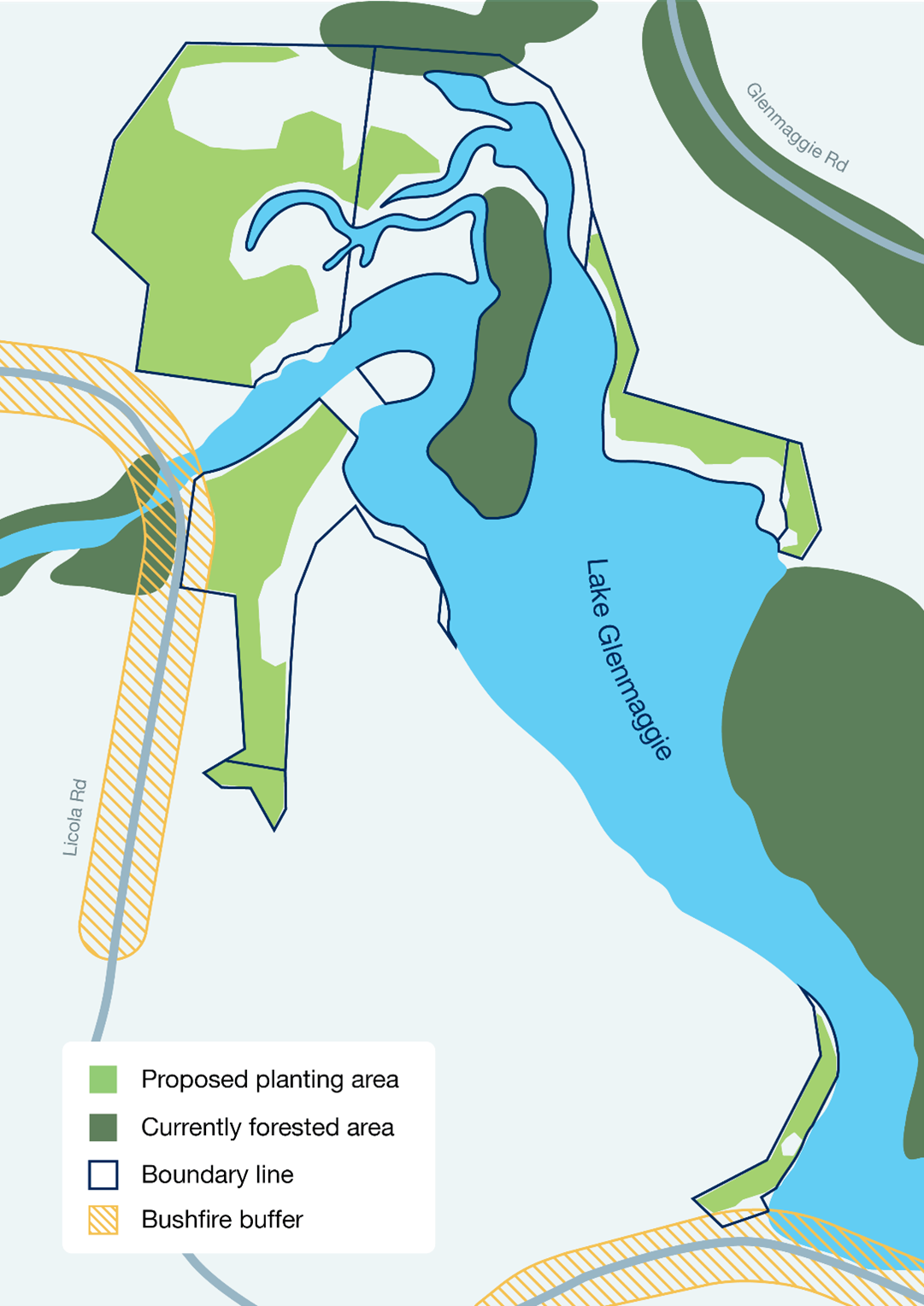
Southern Rural Water has considered forestry assessments at a range of sites and prioritised planting at Lake Glenmaggie. In September 2025 we finished planting 14,250 trees and shrubs at the site over 13 hectares. This site is expected to sequester around 3,800 tCO2-e over the next 25 years.
The project will improve the condition of the land and waters at the headwaters of Lake Glenmaggie by protecting the waterway from livestock and erosion. It is also expected to improve the habitat for a wide range of flora and fauna that are native to the area.
We want to thank our appointed contractors, Traditional Owners, Heyfield Public School and St. Andrews Primary School who have been involved with the project.
Blue Rock Lake
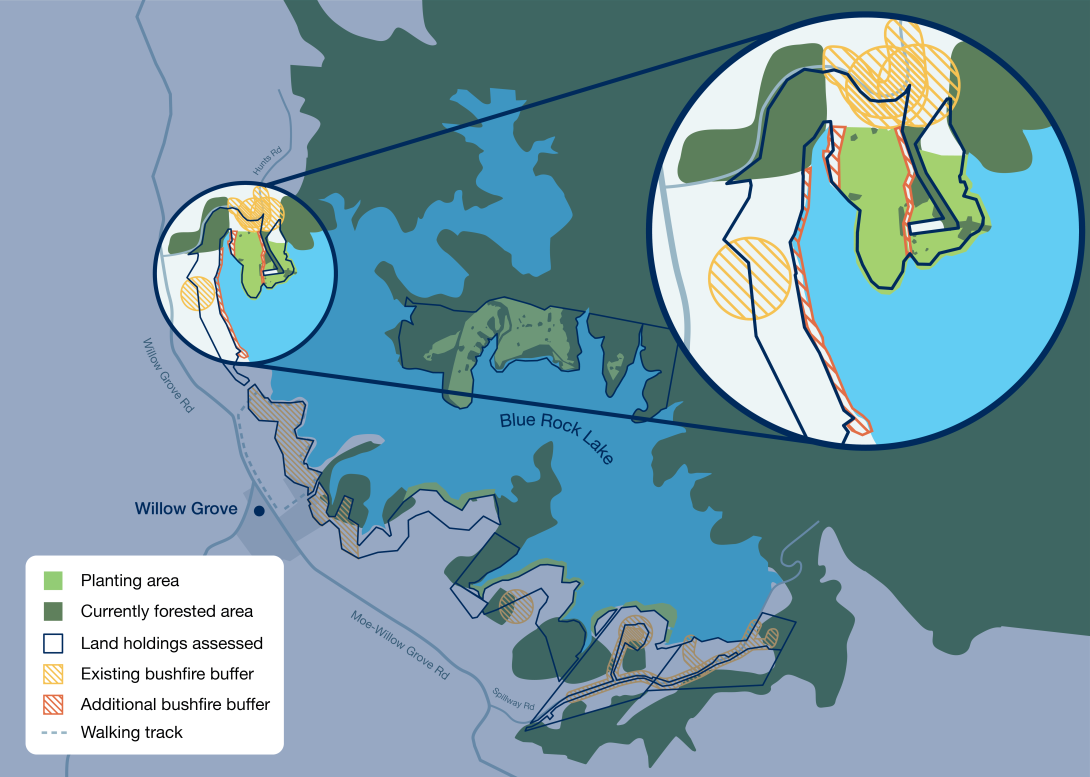
After extensive community consultation, Southern Rural Water identified several suitable suites at Blue Rock Lake. Southern Rural Water narrowed down the suitable sites to 75 hectares, which was presented to the community during consultation.
After listening to the community, we heard that concerns regarding bushfire risk had been addressed by restricting planting to 75 hectares (from the available 200 hectares that Southern Rural Water owns at Blue Rock Lake) and ensuring these locations are well away from the Willow Grove township.
A small number of people expressed they’d like additional bushfire buffers around the Hunts Road area. We committed to listening to all feedback provided by the community and in response, we’ve removed a further four hectares of plantings at the north-west corner of Blue Rock Lake around Hunts Road.
After narrowing these sites down in line with community feedback, Southern Rural Water will plant across 71 hectares at sites located away from the Willow Grove township.
Initially, planting was going to take place in winter 2026, however, we are now looking to plant in winter 2027.
More Information
-
Can I see a map of plantings at Lake Glenmaggie?
-
Can I see a map of plantings at Blue Rock Lake?
-
What informed the planting decision at Blue Rock Lake?
Along with technical reviews and assessments, which covered bushfire risk, cultural heritage, land suitability and visual amenity, Southern Rural Water undertook extensive community consultation, including a drop-in session, face-to-face meetings, phone conversations and information available on Southern Rural Water’s website and social media.
The decision was informed by feedback from the community, and in engagement undertaken with licence holders (people who currently have access to Southern Rural Water land), the Willow Grove Country Fire Authority and other key stakeholders.
-
At Blue Rock Lake, how was the bushfire risk assessed?
A technical expert produced a bushfire risk analysis that made recommendations on the suitability of sites for planting and mitigations to be implemented for the planting proposal.
This also included identification of the bushfire landscape risk and likely radiant heat impacts. The analysis included site visits, assessment of available information including municipal fire management plans, bushfire planning overlays, and legislation.
The analysis considered topography and its influences on bushfire behaviour, including under conditions such as prevailing winds. The full report can be read here.
Further, the planting proposal does not change the Bushfire Management Overlay, which is a Victorian Government planning instrument that applies to land that may be at risk of bushfire to include specific bushfire protective measures. Our proposal contains bushfire buffer zones, which reduces the potential for a Bushfire Management Overlay to be applied in the future.
-
What weed and pest management controls will be in place?
We heard that weed and pest control is important to the community – and we confirm that weeds and pests will be actively managed for the lifetime of the plantings. Weed and pest management is a requirement to be able to claim the carbon credits associated with these plantings and will be the subject of regular audits to ensure this is being undertaken effectively.
Southern Rural Water will maintain and preserve the carbon stored in the trees until 2050 to align with Australian Government requirements. -
What will happen to carbon credits produced?
Our carbon reforestation offsets have the potential to earn one Australian Carbon Credit Unit (ACCU) for each tonne of carbon dioxide equivalent (tCO2-e) stored in the project trees as they grow.
The Clean Energy Regulator will use geo-spatial tools to confirm that the planting activity has happened, verify that abatement is being achieved, and monitor for disturbances. Our offsets will be assessed at regular intervals to confirm they remain compliant.
We will support these assurance mechanisms, and it will enable the regulator to calculate how much carbon has been captured and stored. After verification, we’ll earn one ACCU for each tCO2-e stored by the trees.
With Southern Rural Water, the carbon credits earned will be used to offset our Scope 1 vehicle emissions while we transition all our fleet to zero emissions by 2030. -
What plants are you using?
We have conducted field research and soil testing at all our offsets sites which will be used to inform the species we plant that are compliant with Australian Carbon Credit Unit Scheme, reduce bushfire risk and achieve our carbon offset goals.
We will be planting species that align with the local Victorian Ecological Vegetation Class (EVC) benchmark with a higher tolerance for drier and more variable climatic conditions to ensure greater success establishing and maintaining resilient reforested areas at our sites.
The final summary report for the Carbon Reforestation Offsets Project can be viewed here.
This report considered the suitability of offsets sites at Blue Rock Lake, Lake Glenmaggie and Lake Merrimu, and any bushfire risks, cultural heritage and other matters. -
What is the proposed life span for the carbon reforestation offsets?
The project will have a 25-year permanence period under the Australian Carbon Credit Unit Scheme.