

Slow and steady wins the race according to ancient wisdom and this is certainly the case with our water meter upgrade program. We began our program to replace more than 1,000 old-style water meters across southern Victoria in August last year. To date, we’ve replaced 101 meters and aim to complete the program by the end of 2026.
We are replacing surface water meters with an average annual consumption of 10 megalitres and above, and groundwater metres with 20 megalitres and above. The new meters will enable more accurate water reads, ensure a fairer use of water, inform on-farm irrigation planning, and assist with water resource management.
To help us deliver the program across our large service area, we awarded contracts to General Maintenance Hire Services (GMHS) and New Plumbing Solution (NPS) as part of a competitive tender process.
Our service area covers 88,000 square kilometres, stretching from the South Australian to New South Wales border – south of the Great Dividing Range. We’ve divided our region into three work areas: central, east and west. GMHS are working to upgrade our customers’ water meters in the central region and NPS in the east and west regions.
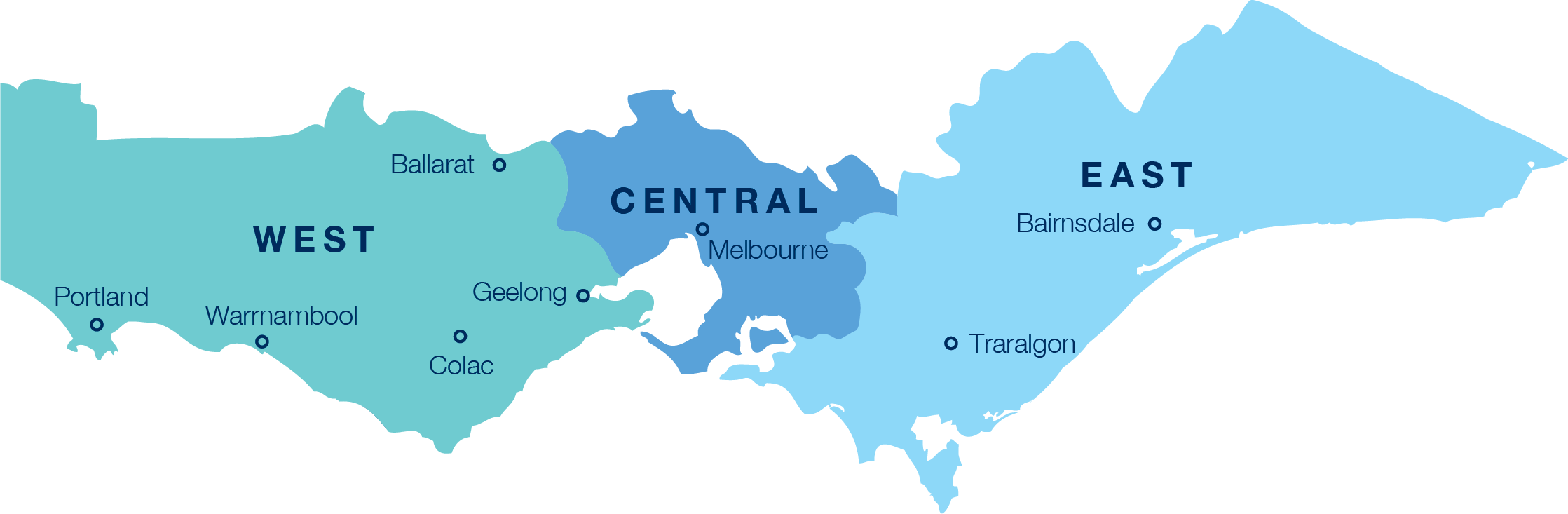
Water meter upgrade program work areas
We sent letters to eligible customers in August to let them know about the upgrade program and how we would work with them to replace their old meter.
Tim Donovan, Southern Rural Water Team Leader Capital Delivery said we then called people to schedule site visits and replacement work around their needs.
“By October we had contacted all customers in our east and west work areas and nearly all in our central area and we were well underway with site investigations across all areas,” he said.
“Coordinating site visits and completing meter replacements is a steady process, and in most cases everything runs smoothly.”
“However, like any large project we have experienced a few challenges along the way and we’re learning from these so we can improve efficiency as the program progresses,” he said.
Tim said customers can help ensure a smooth installation by taking a few simple steps ahead of their scheduled works.
“To help us safely access the works area we need the current meter to be clear of debris and vegetation,” he said.
“We also require the meter to be isolated, where possible, by closing upstream and downstream isolation valves. Pipelines should be de-watered through a valve or drain point, pumps should be turned off, and any electrical supply associated with pumps or meter infrastructure safely isolated prior to our arrival.”
“It’s also important to note that when testing the new meter, the customer needs to operate their pump while the contractor is present. This allows both parties to confirm the installation has been successful and identify and rectify any leaks around the meter if required,” he said
The project is replacing older mechanical meters with modern digital meters that use electromagnetic technology to measure water flow.
Tim said the new digital water meters offer significantly improved accuracy and longer service life because they do not rely on moving mechanical parts that wear over time.
“Many older meters use a mechanical propeller or turbine inside the pipe that spins as water flows through,” he said.
“The rotating propeller drives a series of gears which in turn operate the meter dial to record water use. Over time, wear and tear, debris, sediment, or corrosion can slow or damage these moving parts, which can reduce measurement accuracy and increase maintenance needs.”
“Digital meters using electromagnetic technology apply a magnetic field across the pipe. As conductive water flows through this field, it generates a voltage detected by electrodes, with the signal directly proportional to water velocity. This enables highly accurate, real-time measurement of water use without any moving parts.” he said.
Southern Rural Water’s upgrade delivers on meeting Victoria’s Non-urban Water Metering Policy and national metering standards under the National Water Initiative Agreement (NWI), to which all State and Territory governments are signatories.
Visit our metering page for more information about our Metering Action Plan